
I just survived 2 weeks of breast milk weaning hell. Those 2 weeks felt like a literal lifetime but doesn’t everything feel like it will last forever when you’re in the thick of it?
Maybe this article should be a series of sh*t no one tells you about when you’re postpartum. But actually, why aren’t we talking about this more? There is so much information about trying to conceive (which I recently read is now called “Trimester Zero”) and pregnancy but there is so little being said about the Fourth Trimester (aka the first 12 weeks postpartum). Do other mamas suffer in silence? Postpartum is a magical time with a newborn but it’s also really freeeeeakin hard - emotionally, physically, alllll the feels.
Most likely any mama who delivers a baby via C-Section or Vaginal will have to wean from breastfeeding / pumping at some point, regardless of whether you opt to breastfeed or not. A quick rundown on how breast milk develops (because I didn’t really understand it with my first pregnancy).
How breast milk works:
»During pregnancy, our two sex hormones (Estrogen & Progesterone) stimulate the breast tissue to grow and develop milk making structures. This is why pregnant mamas boobs get bigger during pregnancy. The main hormone for producing breast milk is called Prolactin. Estrogen & progesterone actually block Prolactin during pregnancy. But, despite the suppression of prolactin, the breast tissues do produce colostrum as early as the second trimester. Colostrum is the antibody rich early milk, often called liquid gold.
»24-48 hours after delivery: Estrogen & progesterone drop drastically, which allows prolactin levels to rise. Colostrum starts transitioning to mature milk.
»2-5 days after delivery: Breasts start to feel full, maybe engorged and warm. Timing depends on many factors - mamas who have given birth before may see mature milk come in earlier.
»2 important hormones we need to understand for breast milk & weaning.
Prolactin - Drives milk synthesis & operates on a supply/demand basis
Oxytocin - Responsible for milk ejection, or the milk let down reflex. You may know about Oxytocin as the “feel good” hormone. It’s triggered by sucking (via baby or pump) but also a baby’s cry or just thinking about your baby.
Breast milk operates on a supply/demand basis. When your baby is hungry and feeds you produce milk. The more your baby feeds (or more you pump) the more milk is produced. This is all designed to meet the baby’s need for milk to grow. Crazy, right?
This also means that the less the baby feeds (or less you pump) the less milk is produced. The female body is incredible. We can communicate with prolactin to help make more milk or make less milk.
What I didn’t realize was that you can’t really stop making milk cold turkey. You can’t tell prolactin: “Hey, I’m done breast feeding so please stop milk production.” It doesn’t really work like that. Your body needs time to wind down. It’s a gradual process.
So, let’s talk about what it means to wean, how to do it, the symptoms you’ll likely experience and how you can get through the other side.
Disclaimer - I’ve now weaned during both my postpartums at 6 weeks so my experience may be different from others who are weaning earlier or later in their journey. And, my experience is my own. Every mama has her own journey.
What is Weaning?
Weaning is the process of reducing or eventually stopping breastfeeding (or pumping) of breast milk. Milk supply naturally decreases as feeds are dropped.
How to Wean
Gradually :) do I say and not as I do - as I was desperate and weaned very quickly. I worked with Claude to develop an aggressive weaning schedule over the course of 2 weeks. I was an oversupplier, so I probably should have weaned over a month or more, but I was eager to close this chapter of my postpartum journey.
Typically you would replace one feed every week with a bottle of formula. Let’s say you are feeding your baby during this schedule - 7am, 10am, 1pm, 4pm, 7pm, 1am, 4am… replace one of these feeds with a bottle on week 1 and then week 2 replace another and so on, and so on. This gradual weaning process allows your body to slowly decrease milk production without all those awful side effects.
But, let’s say you are exclusively pumping with that same schedule. You could either do the same process by dropping one pump each week or you could slowly decrease the pumping time. Both options work and it depends entirely on your body, how long you have breastfed or pumped. I did a combo of both - dropping a feed and decreasing pump times.
Recommend partnering with a lactation consultant or Claude to build a weaning schedule that helps you avoid the nastier side effects of weaning too fast.
Side Effects of Weaning
Dare I say that weaning was harder than pregnancy, delivery, and the sleepless nights combined. There is nothing worse to me than the weaning process. Here’s what I endured and what many mamas experience.
Engorged breasts: is the feeling of fullness in your breasts, like the milk just needs to explode out
Clogged milk ducts: feel like a hard lump in one or both breasts. This happens when milk isn’t drained properly (inefficient latching or decreasing pump sessions) and causes a milk backup which then causes the surrounding milk duct to get inflamed.
Milk blebs: are related to clogged ducts and look like a small white dot (or blister) on the nipple. It can either be skin that grows over the milk duct opening or thickened/dried milk gets stuck at the opening
Mastitis: is inflammation of the breast tissue and progresses to an infection of the breast and must be treated. It’s caused by a few things but all related to clogged ducts and inefficient feedings. You’ll know you have it if you have red patches on your breasts, a fever, flu like symptoms, and those nasty clogs.
Breast milk leakage: happens when milk leaks from your nipples without any stimulation. Wear those breast pads!
Tender/inflamed breasts
This was a deal breaker for me. The inflammation and engorgement made it so painful to hold my toddler & newborn. There were times I had to pass my boys to my husband to hold or feed because the pain was just too much
Heightened emotions - anxiety, sadness, frustration, anger
How you wean affects how intensely you'll feel this. If you wean too quickly, you'll likely experience a sharp rise in these emotions — largely because of prolactin and oxytocin, and what happens when we try to suppress them too fast.
Let’s talk about the hormonal effects of weaning too quickly (which is what I experienced).
»Prolactin keeps milk production going so when you start to wean quickly milk production starts to decline. Prolactin also delivers calming, sleep promoting feeling so when you wean too quickly your mood can drop real fast.
»Oxytocin is released via the milk let down reflex so when stimulation stops so does the release of oxytocin (remember, the feel good hormone). So, you may experience a sense of loss, irritability, feeling ‘off’ emotionally.
»Estrogen & Progesterone are suppressed during breastfeeding so when you stop they start to climb back up and can trigger ovulation (so be cautious mamas!) but also PMS symptoms such as mood swings
In summary: weaning too quickly can send your hormones spiraling and tip you into an emotional surge.
Treatment for Weaning Pain
This doesn’t last forever. Patience, patience, patience. Easier said than done.
First, use this acronym (BAIT) for treatment.
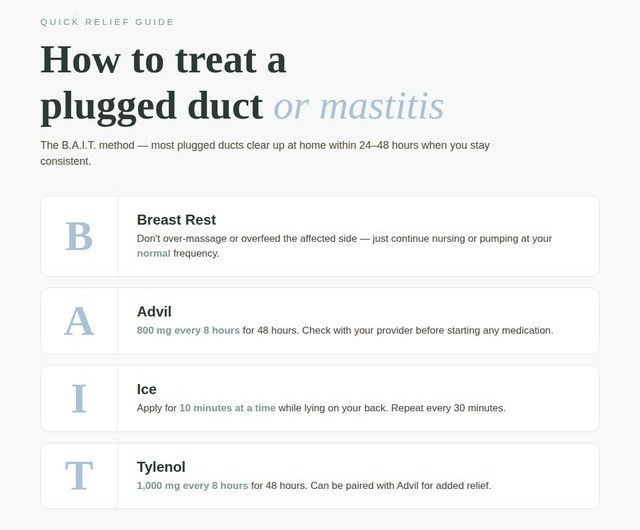
Additional tips & tricks:
Cabbage leaves - Chill them in the fridge or freezer; they conveniently mold to your breasts, and there's a compound in cabbage believed to help suppress prolactin and reduce inflammation and swelling.
CaboCreame - Developed by an OBGYN, this cabbage-extract topical cream helps relieve engorgement pain, soothe clogged ducts, and suppress milk supply.
Ice - these breast ice packs or frozen peas do the trick
Sage & peppermint tea - herbal remedies that are known anti-galactagogues, meaning they can decrease or dry up your breast milk supply. You can make the blend yourself or buy Earth Mama No More Milk Tea Blend
Sudafed - A decongestant I discovered deep in a Reddit thread late one night. Its decongestant properties may help reduce prolactin. Consult a medical provider before trying this.
Lymphatic Drainage - verrrrry gentle breast massage (like petting a cat) that removes excess fluid and swelling towards your lymph nodes (near your armpit)
Sunflower Lecithin - helps remove the stickiness of breast milk and prevent the fat in the milk from clumping which can lead to clogged ducts.
There are some older methods that are outdated and not recommended. This includes heat (which actually helps to stimulate milk ejection - the opposite of what you want) and deep massage (which can inflame the breast tissue even more). I learned this the hard way by doing deep massage which aggravated my breast tissue even more.
My experience on the other side
Every mama’s experience weaning or the feeling post weaning will be different. With my first I had extreme sense of guilt and sadness about stopping. Many say they mourn their last breastfeed. With my second, I felt an immediate sense of relief when I woke up with no breast engorgement, no clogged ducts, no inflammation or breast tenderness. This is my first week not pumping, having my boobs back to pre-pregnancy size and feeding my son all formula. I feel amazing. And, my son is doing amazing.
AI helped me so much but I will not discredit lactation consultants who are amazing and will not replace AI. I had a lactation consultant come to my house for a physical exam when I was in the depths of weaning hell. Sometimes having a real human professional validate your concerns can help, even if you think AI has given you all the tips & tricks.
For those who are in the depths of weaning hell, just know you are not alone and it won’t last forever. Hopefully these tips & tricks help you get through the other side.
xx
Caroline